Eggstreme Farming Best Chickens: Every Breed Ranked for Profit
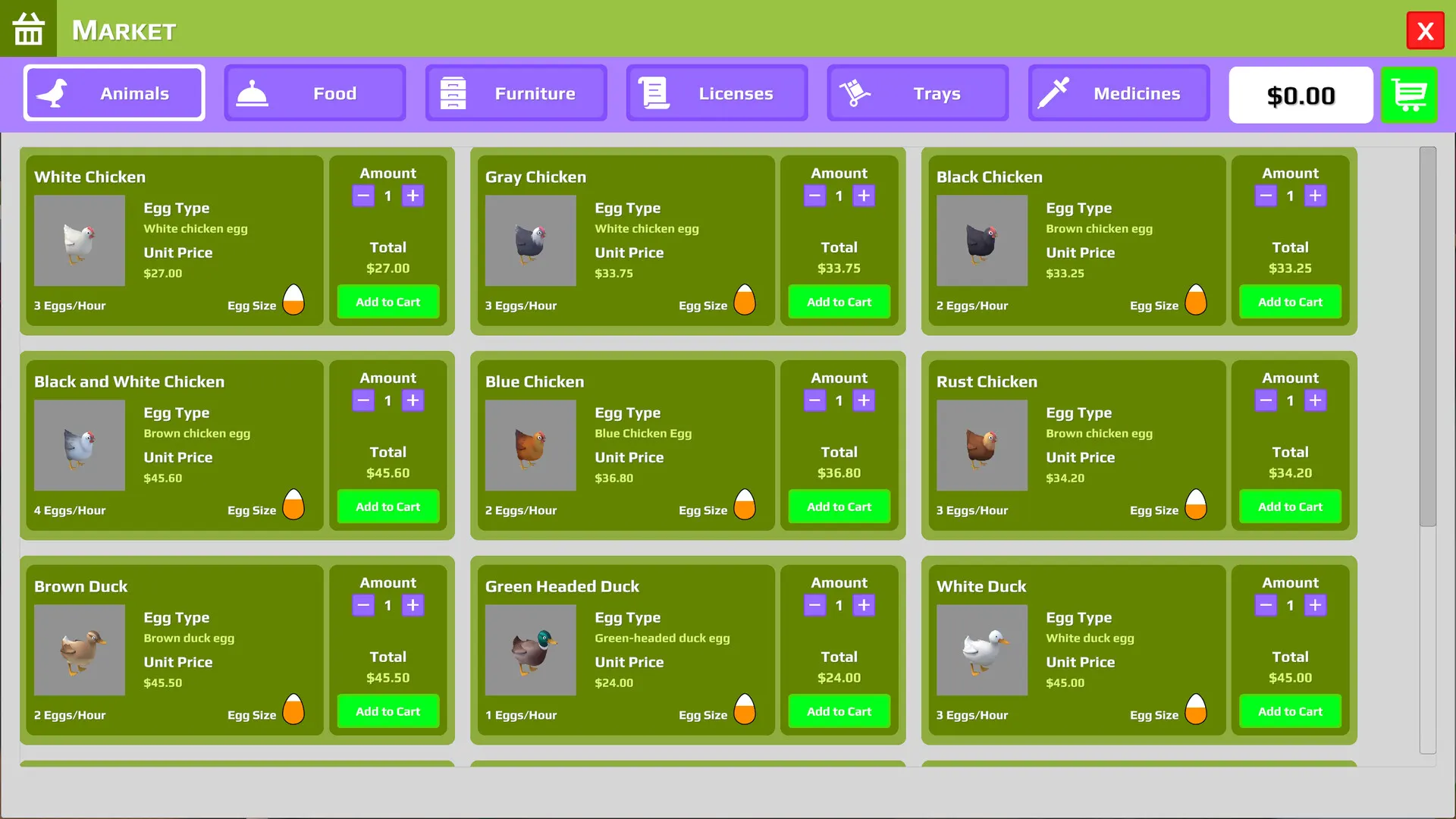
Chicken breed choice is the single biggest profit decision you make per pen. The official market screen lists every breed’s stats in one place — here they all are, ranked, with the upgrade path that launch-week runs actually used.
Every chicken, by the official numbers
| Chicken | Egg type | Eggs/hour | Egg size | Market price seen |
|---|---|---|---|---|
| Black and White | Brown | 4 | Large | $45.60 (official) / $76 in stream footage |
| Gray | White | 3 | Large | $33.75 (official) / $50 in footage |
| White | White | 3 | Medium | $27.00 (official) / $32 in footage |
| Rust | Brown | 3 | Medium | $34.20 (official) |
| Black | Brown | 2 | Medium | $33.25 (official) |
| Blue | Blue | 2 | Medium | $36.80 (official) |
The ranking, with reasoning
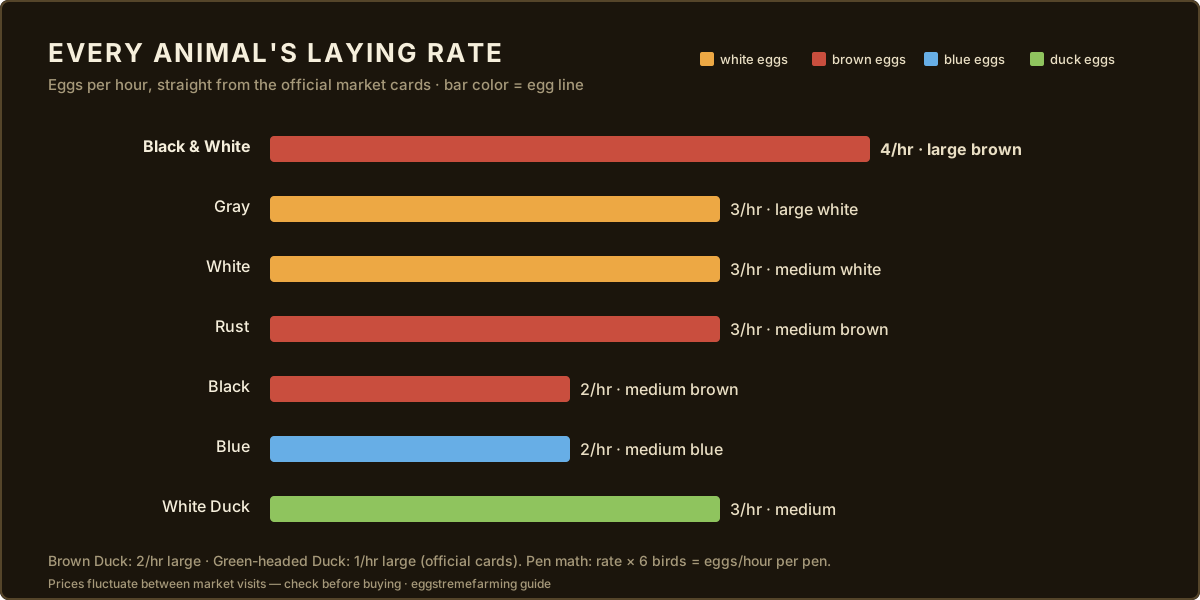
All nine documented animals by laying rate — the black-and-white chicken leads at 4/hr.
1. Black and White Chicken — the endgame earner. Four eggs an hour at large size in the highest-value color line is the best production card in the launch build. Six of these in a pen out-produce everything else you can license at that stage; a full pen is roughly a $37–45 tray every hour and change of laying time.
2. Gray Chicken — the first real upgrade. Same three-an-hour pace as the white, but large eggs, which outsell medium by 20–25% per egg. A gray pays back its premium over a white within roughly two in-game days, then it’s pure profit.
3. Rust Chicken — the brown workhorse. Three medium brown eggs an hour is solid brown-line production; it’s the value pick for a brown pen if black-and-whites are priced out of reach that day.
4. White Chicken — the starter. Three medium whites an hour on the cheapest license in the game. Perfectly fine for days 1–3; you’ll sell the whole flock when the brown license lands.
5. Black Chicken — the cheap brown option. Only two eggs an hour, which is why it’s priced lower than the other brown layers. Fine as a pen-filler while saving for black-and-whites; not a pen you keep.
6. Blue Chicken — the novelty. Two medium blue eggs an hour at a premium price. Blue eggs sell, but nothing about the stats justifies the slot over a black-and-white. Buy one when money doesn’t matter, or for the license progression.
The upgrade path that works
-
Days 1–2: white chickens to six heads. Cheapest path to a full pen producing ~18 eggs/hour.
-
Day 2–3: replace whites with grays one by one as cash allows — sell each white at the sell machine to fund part of it. Large eggs start compounding immediately.
-
License brown (about $45) the moment you can afford license plus one brown-layer bird.
-
Fill the brown pen toward black-and-whites, using rust or black birds as budget placeholders if prices are spiky.
-
Keep one white pen running (or re-buy cheap whites) while the brown pen scales — two income lines beat one fancy one in the early-mid game.
Reading the market card before you buy
Every animal card shows egg type, eggs/hour, egg size and unit price. The decision rule is just multiplication: eggs/hour × per-egg value of that size and color. Per-egg pricing lives in egg sizes & prices; how the duck lineup compares is in chicken vs duck profit.
FAQ
Are white chickens worth keeping after the brown license? As workers, no — sell them and rebuy cheap whites if you need a third income pen later. As a buffer against broke days, one white pen is decent insurance.
Does the gray chicken lay white or brown eggs? White, at large size. The brown lines belong to the black, rust and black-and-white chickens.
Is there a rooster? Are any breeds faster? No rooster appears in the launch market, and eggs-per-hour is fixed per breed — nothing observed changes a bird’s lay rate.