Eggstreme Farming Beginner Guide: Your First Days on the Farm
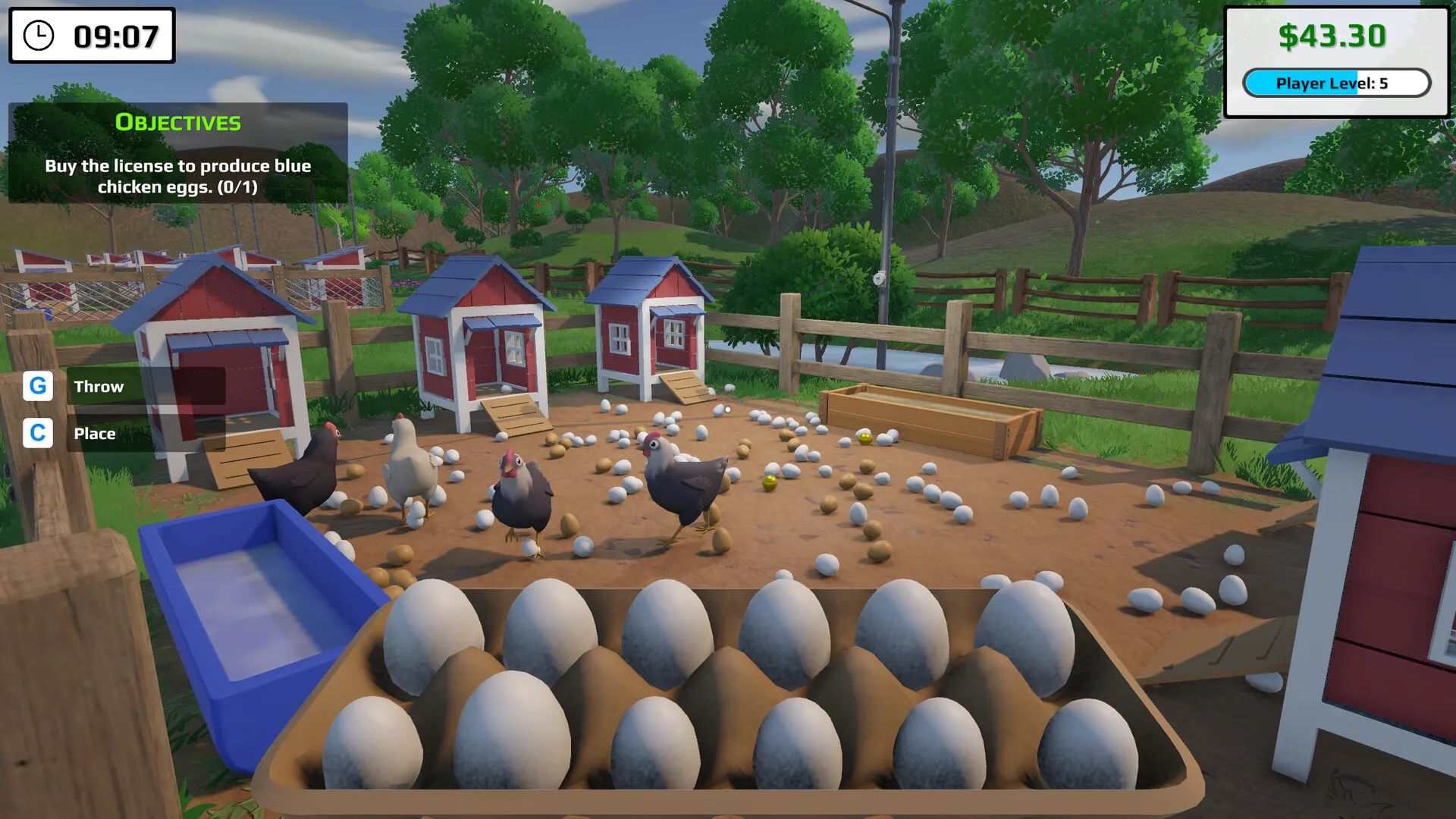
Eggstreme Farming drops you on a small farm with $100, player level 1, and zero hints about what to touch first. The good news: the first hour is always the same loop, and once it clicks, everything else (ducks, geese, machines, loans) is that same loop with more zeros. Here’s the full first-day walkthrough, verified against launch-week gameplay.
The farm at a glance
Walk around before buying anything. The map is small and fenced — you can’t leave it. You’ll find:
-
Your house with a bed (you sleep here to skip the night) and a management PC nearby.
-
The market kiosk with tabs for Animals, Food, Furniture, Licenses, Trays, Medicines and Water.
-
The bank, which offers small loans early on.
-
A row of animal pens — chicken, duck, goose and turkey coops — each with a sign showing which species belongs there.
-
The vending machine, which is where you sell eggs, animals and egg crates. Don’t confuse it with the market; one sells to you, the other buys from you.
Everything you buy arrives in boxes on the ground near the market. Walk up and unpack them (the game shows an on-screen Unpack prompt — boxes can only be opened in valid spots, which trips up every new player at least once).
Your first hour, step by step
-
Buy the white chicken egg license (Licenses tab, roughly $40). No license, no chickens — the market only stocks animals you’re licensed for.
-
Rent chicken pen 1 at the management screen. It costs a few dollars per day and holds 6 animals.
-
Buy one white chicken (about $27–$32 — animal prices shift between market visits).
-
Clean the pen before moving in. Grab the broom leaning by the pens and sweep the old mess out. Cleaning gives XP, and you’ll be doing it every morning anyway.
-
Unpack and place the chicken in its pen. You physically carry the bird — the Place prompt sets it down.
-
Buy feed and water. One package of feed fills the pen’s hopper; water bottles fill the blue water container. Organic chicken feed runs about $8 a package and lasts a surprisingly long time.
-
Buy a tray of chicken eggs (the small 6-slot trays cost almost nothing, 5 for about $2).
-
Wait for eggs, fill the tray, sell it. Carry the tray to the vending machine, drop it in the sell slot, and confirm. The machine shows exactly what each egg size is worth before you confirm.
-
Sleep in your bed when the chickens doze off. You wake up at 5:00–6:00 in the morning.
That’s the entire game loop: keep birds alive and comfortable → collect eggs into trays → sell trays → reinvest the money into more/better birds and licenses.
How the day cycle works
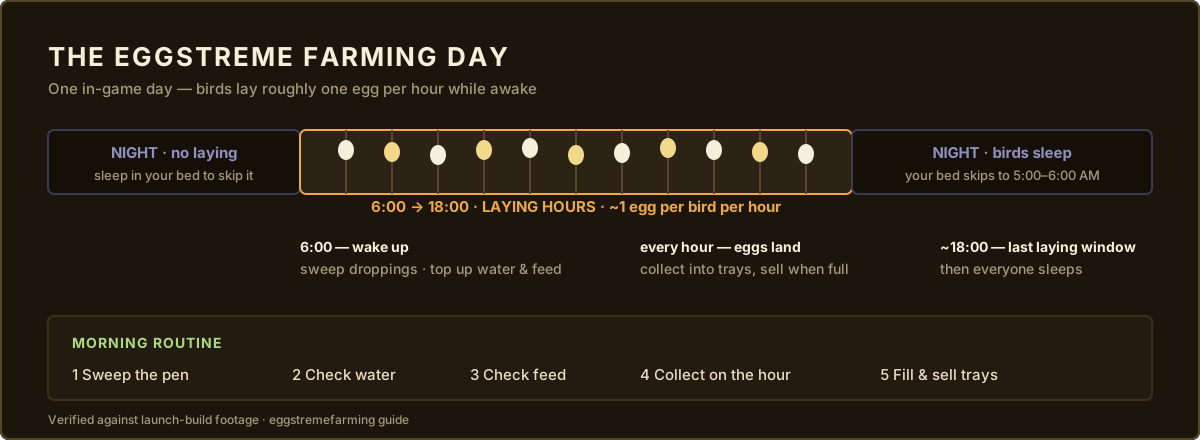
The full day at a glance — sweep, water, feed, collect, sell, sleep.
-
Birds wake at 6:00 and lay roughly one egg per in-game hour — sometimes two or three in a burst.
-
The last laying window is around 18:00. After that they go to sleep, and nobody lays at night.
-
Every morning the pens are covered in droppings. Sweep them with the broom; it’s quick and pays a little XP.
-
Fast forward doubles game speed when you’re just waiting for the next laying hour. It tends to reset to normal speed at the start of each day.
-
Sleep only works once the animals have settled for the night.
What all the UI means
-
Top left: the clock. Laying happens on the hour, so the clock tells you when to walk the pens.
-
Top right: your cash and player level. Nearly everything you do — collecting, cleaning, selling, finishing objectives — gives XP, and levels unlock market items (bigger trays, better feed, machines).
-
Left side: the auto-generated objective list. It pings you to buy licenses, refill containers, collect 20 eggs and so on. It’s a decent checklist, but it will try to rush you into a second pen before your first one is profitable — ignore it when your gut says otherwise.
-
Hovering an animal shows its hunger, thirst, health and medicine status. More on that in the health & medicine guide.
First-day mistakes that cost real money
-
Throwing items you meant to place. The Throw key is right next to Place. If you chuck a tray or a tool, walk over and pick it up — but players have lost brooms into the trash this way, and replacements aren’t obviously purchasable.
-
Buying the priciest feed immediately. Feed tiers mostly affect capacity and small health/thirst bonuses; organic is plenty for your first pen.
-
Ignoring water. Feed lasts all day; water drains faster with more birds. An empty water container is the most common “why is my chicken not laying” cause.
-
Not keeping a cash buffer. Eggs only make money once they’re in a tray and sold. If you’re broke with a full pen and no trays, you’ll be selling a chicken to cover it — it happens to everyone once. There’s a whole page on digging yourself out of zero cash.
What to unlock first
The intended ladder in launch week: white chicken eggs → brown chicken eggs → blue chicken eggs → duck licenses → geese and turkeys, with brown licenses around $45 and duck licenses costing more. Along the way, level unlocks matter as much as money: bigger 30-egg trays arrive around level 10, the Egg Collector becomes affordable in the mid-teens, and the Incubator sits behind a level 50 wall. The early game strategy page turns this into a day-by-day plan.
Controls worth knowing
Interaction prompts appear contextually: Place/Confirm (with Rotate when positioning), Throw for tossing items, Unpack for delivery boxes, and a Move action for repositioning machines you’ve already placed. You can only carry one loose item (tray, egg, bottle, bird) at a time — volume comes from trays, crates and machines, not from your hands.
Where to go next
-
Early game strategy — a day-by-day plan for the first week.
-
How to make money — the earning loop in numbers.
-
Feed & water — keep the birds producing.
-
Egg trays & crates — trays are per-species, which surprises everyone.